THE K9EDGE EXPERIENCE

Understand
YOUR dog.

Support their nervous system.
Guide their behaviour.
Create everyday success.

The person behind K9Edge

Meet Chris.

Understanding behaviour. Recognizing subtle changes. Getting ahead of challenges rather than reacting to them.

My professional background includes more than 30 years in public safety, where understanding behaviour, assessing environments and making proactive decisions were fundamental to my work.

Today, I bring that same analytical and proactive approach to canine behaviour, supported by professional education in animal learning, behaviour modification and training.

My goal is not simply to train your dog. It is to give you the knowledge, confidence and practical skills to guide your dog through everyday life.

30+
Years of public safety experience
CPDT-KA
Certified Professional Dog Trainer – Knowledge Assessed
Professional focus Reactivity • Aggression • Fear-based behaviours • Nervous system regulation • Puppy development • Service dog training education
02 / Learning to see differently

How well do you really know your dog?

Your dog is communicating with you throughout the day. How much of that communication are you recognizing? Some of the most valuable information comes from behaviours that are easily overlooked.

Select a behaviour to discover more
01 The paw lift
What might it mean?

A raised paw may accompany uncertainty, anticipation or concentration. What is your dog observing, and what else is changing in their body language?

02 The lip lick
What might it mean?

A subtle lip lick may accompany discomfort, anticipation or stress. Recognizing the signal is important, but understanding the context is equally important.

03 The shake-off
What might it mean?

A full-body shake when your dog isn't wet may accompany a transition following excitement, tension or an interaction. What happened immediately before it?

04 The fixation
What might it mean?

Sustained, intense attention may indicate increasing arousal. Can your dog still disengage, orient toward you and respond to familiar guidance? This information can help us make proactive decisions.

05 Barrier frustration
What might it mean?

A leash, fence or window can influence how your dog responds to the world. Frustration and fear can produce similar outward behaviours. Understanding the underlying motivation matters.

06 The head turn
What might it mean?

Turning away may communicate discomfort, avoidance or a desire to disengage. Recognizing these subtle moments can help us respect personal boundaries and support more comfortable interactions.

Recognizing behaviour is one thing. Understanding what it means for YOUR dog is another.

No single behaviour tells the entire story. We need to consider the environment, your dog's history, accompanying body language and the circumstances surrounding that behaviour. This is where our work together begins.

Understanding your dog's state

Before we guide behaviour, we need to understand state.

Your dog's capacity to process information, make decisions and respond to familiar guidance can change from one moment to the next. Understanding where your dog is along this continuum helps us recognize when to guide, when to create space and when to support recovery.

Explore the three states
Golden retriever sitting on a loose leash and looking toward its handler
01 / Problem-Solving

Available to learn.

Your dog can process information, explore, engage with you and respond to familiar guidance. This is where we can develop skills, reinforce behaviours and build predictable patterns of success.

What might we observe?
  • Relaxed or flexible body language
  • Voluntary engagement and check-ins
  • Ability to disengage from distractions
  • Responsiveness to familiar guidance
Alert black and white dog standing with attention directed away from its handler
02 / Transition

The window of opportunity.

Your dog's attention is shifting. Arousal may be increasing and their responsiveness may begin to change. Recognizing this transition allows us to get ahead of behaviour rather than waiting to respond to it.

What might we observe?
  • Increasing attention toward a stimulus
  • Changes in posture or body tension
  • Reduced spontaneous engagement
  • Delayed or changing responsiveness
Brown dog barking and lunging forward against a leash
03 / Instinctual

Responding to immediate circumstances.

Your dog's response may be increasingly driven by immediate emotional and instinctive processes. Familiar guidance may become difficult to respond to. Our priority shifts toward safety, reducing pressure and supporting recovery.

What might we observe?
  • Intense barking, lunging or attempts to escape
  • Freezing or defensive responses
  • Difficulty disengaging from a stimulus
  • Significantly reduced responsiveness

These three states provide a practical framework for observing behaviour and responsiveness. They are not discrete neurological categories, and a single behaviour or photograph cannot establish a dog's internal state.

Don't wait for the reaction. Recognize the transition.

Some of our most valuable opportunities occur before the behaviour we are concerned about becomes obvious.

By recognizing subtle changes in body language, attention and responsiveness, we can make proactive decisions about distance, movement, engagement and environmental pressure.

If your dog is already experiencing an intense fight, flight or freeze response, our immediate objective may need to shift from teaching a new skill to supporting safety and recovery.

Thresholds.

Every dog has limits to what they can comfortably process in a given moment. Those limits are influenced by their environment, experiences and current state.

Stress stacking.

Experiences throughout the day can have a cumulative effect. Something your dog managed yesterday may be much more challenging for them today.

Distance.

Creating appropriate space can reduce environmental pressure and help restore your dog's capacity to engage, process information and respond.

State before behaviour.

Understanding your dog's state helps us determine not only what to teach, but when and how to teach it. This is fundamental to our proactive approach at K9Edge.

03 / Learning to communicate

Your dog is always learning.

Every interaction provides information. Your dog is constantly learning from their environment, their experiences and the feedback we provide. Our objective is to make that feedback clear, consistent and meaningful.

Golden retriever offering a calm sit
01 / Behaviour

Recognize it.

Your dog offers a calm sit. Recognize the behaviour you want to see more often, even when you haven't specifically asked for it.

Handler enthusiastically celebrating the dog's behaviour
02 / Marker

Mark it.

Celebrate that moment with a clear, positive marker. Let your dog know exactly which behaviour they got right.

Handler delivering a food reward to a golden retriever
03 / Reinforcement

Reward it.

Follow the marker with something your dog values. A meaningful reward helps increase the likelihood that the behaviour will be offered again.

“Yes!”

A moment of clarity in a world full of information.

A marker becomes meaningful through association with reinforcement. It allows us to identify the precise moment our dog offers a desired behaviour and communicate that a reward is coming. Timing, consistency and meaningful reinforcement are what give the marker its value.

Different paths to the same destination.

There are several ways we can develop behaviour. Understanding these different approaches helps us choose the most appropriate way to teach a skill based on your dog, their experience and the objective we are working toward.

Golden retriever offering its paw to a handler indoors
01 / Capturing

Recognize what already exists.

Capturing involves recognizing a behaviour your dog offers naturally, marking that moment and reinforcing it. We don't need to physically guide the behaviour or ask for it first.

For example

Your dog spontaneously offers you a paw. By marking and rewarding that behaviour when it occurs, we can increase its frequency and eventually associate it with a cue such as “Shake.”
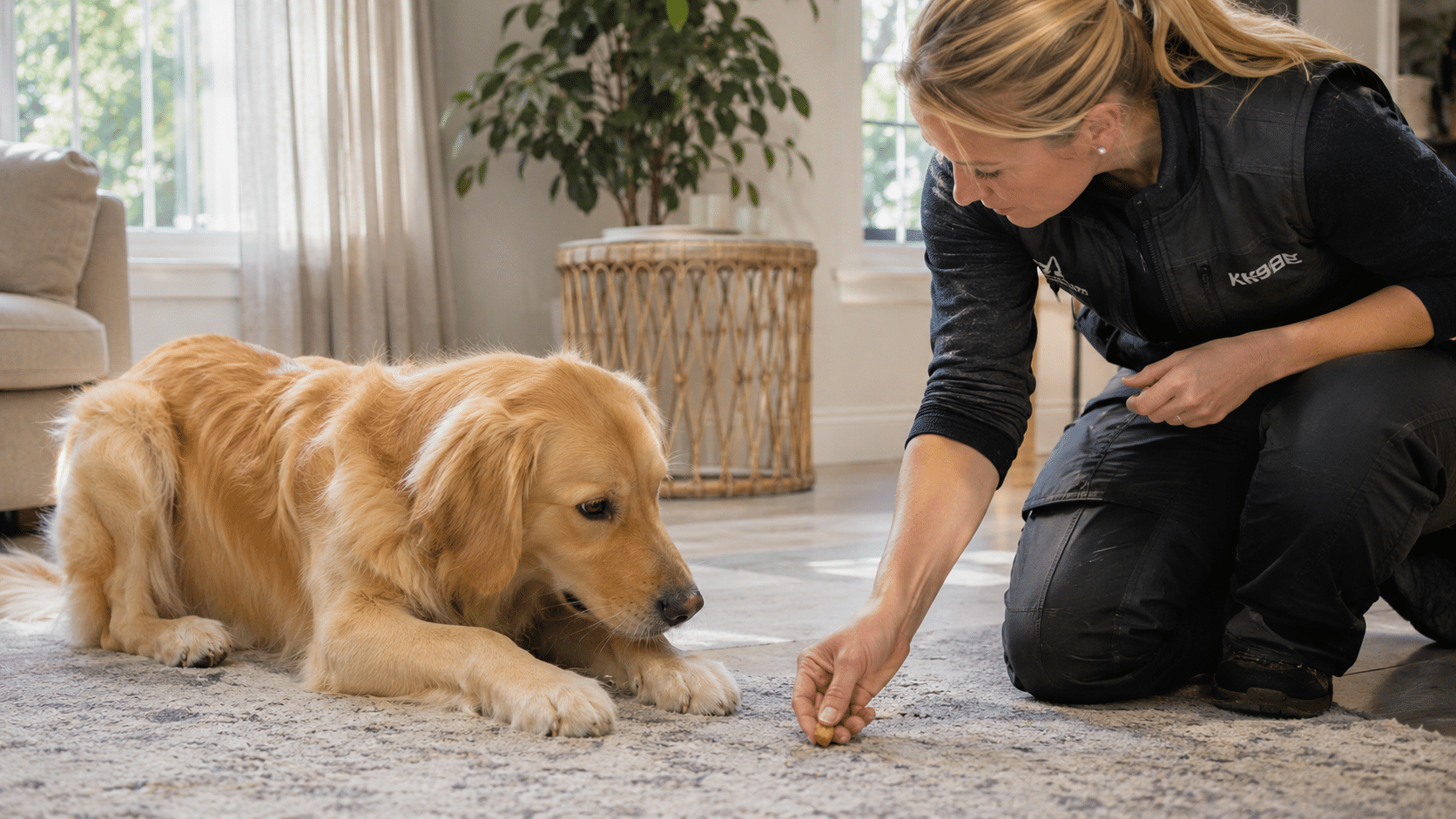
Handler using a food lure to guide a golden retriever
02 / Luring

Guide the movement.

Luring involves using something your dog values, such as food, to guide their movement toward a desired behaviour.

For example

We guide your dog's movement using a treat, mark the desired behaviour and deliver the reward. As understanding develops, we gradually fade the lure so your dog can respond without following food.

Golden retriever participating in a guided indoor learning exercise
03 / Shaping

Build success in small steps.

Shaping involves reinforcing successive approximations of a desired behaviour. Rather than expecting the finished behaviour immediately, we reinforce progress toward it.

For example

To teach your dog to step onto a platform, we might initially reward looking toward it, then approaching it, placing one paw on it and eventually stepping onto it completely.

Timing.

The closer our marker is to the behaviour we want to reinforce, the clearer our communication becomes.

Consistency.

Predictable feedback helps your dog understand what works. Consistency across the household supports learning and reduces confusion.

Predictable sequences.

Simple, repeatable sequences can help your dog anticipate what happens next, build responsiveness and develop confidence through successful experiences.

Don't just notice what goes wrong. Recognize what goes right.

Opportunities to reinforce desirable behaviour exist throughout your dog's day. Learning to recognize and use those opportunities allows us to become more proactive, more effective and more consistent in the way we guide our dogs.

04 / Building the foundation

Calm as a Behaviour.

Before we begin addressing the behaviours that brought you to K9Edge, we need to establish a foundation that supports learning, responsiveness and emotional regulation. One of our most valuable starting points is calm.

Black puppy sitting and looking attentively toward its handler
A foundation for everyday success.

Calm is more than stillness.

A dog can be physically still without being emotionally comfortable. Our objective is not simply to stop movement, but to support a state in which your dog can feel comfortable, process information and remain responsive.

By recognizing and reinforcing moments of genuine calm, we can help your dog develop behaviours that support more successful everyday experiences.

01 / Interaction

Calm as an invitation.

Calm behaviour can become a starting point for interaction. Rather than responding primarily to jumping, barking or demanding attention, we recognize and reinforce more comfortable ways for your dog to initiate engagement.

02 / Everyday behaviour

Calm as a default.

Through consistent reinforcement, your dog can learn that settling, waiting and voluntarily engaging are successful ways to navigate everyday situations without always requiring a cue from you.

03 / Recovery

Calm as a reset.

Familiar calming routines can help support recovery following excitement or challenging experiences. We create opportunities to reduce pressure, reconnect and restore responsiveness when your dog is ready.

04 / Learning

Calm as a learned behaviour.

We develop calm behaviours by recognizing successful moments and reinforcing them consistently. Over time, these experiences can help your dog develop more predictable and comfortable ways of responding to the world.

Simple skills. Meaningful outcomes.

Our work together will introduce practical skills that help you guide your dog's attention, movement and decision-making. These are not simply obedience exercises. Each serves a purpose in supporting communication, responsiveness and proactive behaviour management.

Select a skill to discover its purpose
01 Touch
Connection through movement

Teaching your dog to voluntarily touch a hand target provides a simple way to guide movement, redirect attention and create opportunities for successful engagement without physical pressure.

02 Access Checks
is behaviour even possible?

A simple way for you to determine whether your dog is problem solving, or has instinct taken over. A flooded nervous system moves to survival mode. Understanding when that occurs allows us to respond accordingly.

03 Mark & Move
Recognize and guide

By marking moments of desirable behaviour or voluntary engagement and following with purposeful movement, we can reinforce responsiveness while helping your dog navigate distractions and environmental challenges.

04 Predictable Sequences
touch. sit. relax. reward.

Simple, repeatable sequences help your dog anticipate what comes next. Familiar patterns can support engagement, reduce uncertainty and create opportunities for success in increasingly challenging environments.

05 Stationing
A predictable place to settle

Teaching your dog to voluntarily settle at a designated location provides a practical alternative to moving through busy household spaces. We build positive associations with that location and reinforce comfortable settling.

06 Voluntary Engagement
Make connection worthwhile

When your dog chooses to orient toward you, check in or reconnect, we recognize and reinforce that decision. We want engagement to become something your dog actively offers, rather than something we constantly have to request.

Get ahead of behaviour.

Before

Anticipate.

Recognize situations that may be challenging for your dog. Consider their state, environment and available supporting skills before entering those situations.

During

Guide.

Use appropriate distance, movement, clear communication and familiar skills to support your dog's decision-making and create opportunities for success.

After

Reflect.

Consider what worked, what changed and what your dog communicated. Use that information to make the next experience more manageable and productive.

A foundation of calm.
Simple, repeatable skills.
Everyday success.

Our objective is to give you practical tools that extend beyond our training sessions. Together, we develop the understanding, skills and confidence to guide your dog through the situations that matter most in your everyday life.

05 / Your training experience

Every dog.
Every household.
A different journey.

Our sessions are built around YOUR dog, your environment and the challenges you experience in everyday life.

There is no expectation that your dog will behave a certain way for our appointments. Understanding where your dog is today helps us determine where we need to go together.

Where we begin

Your first session.

Our first appointment is an opportunity to understand your dog, establish a foundation and begin developing strategies relevant to your individual circumstances.

01

Observe & understand.

Explore your dog's history, environment, behaviour, interactions and individual needs through discussion and observation.

02

Establish a foundation.

Introduce practical strategies that support calm, communication, responsiveness and productive interactions.

03

Learn together.

Learn not only what to do, but why we are doing it and what to look for in your dog's response.

04

Create a plan.

Establish practical, achievable objectives to work on between appointments.

Preparing for your appointment

Before I arrive.

A few simple preparations will help us make the most of our time together.

Use this checklist to prepare for your appointment. Selections are not permanently stored.
Training through an Alberta winter

The right conditions.
The right experience.

Training through an Edmonton winter requires flexibility. While we are equipped to work in a wide range of conditions, conducting a session simply because it is scheduled does not always serve the best interests of your dog.

Snowfall, freezing rain, extreme cold, poor visibility and rapidly changing road conditions can affect both travel and the suitability of planned training activities.

45 min
Travel time allotted between sessions
±15 min
Scheduled arrival window

Your trainer may arrive up to 15 minutes before or after your scheduled start time, subject to traffic and road conditions. If a delay exceeding 15 minutes is anticipated, you will be contacted by text to determine whether to proceed or reschedule.

What guides our decisions

Safety.

Road conditions, visibility, extreme temperatures, icy surfaces and other environmental hazards affecting clients, dogs and trainer.

Your dog's wellbeing.

Individual cold tolerance, physical comfort, stress levels and your dog's capacity to engage, learn and process information.

Training effectiveness.

Whether the environment and conditions allow us to achieve meaningful training objectives and create a productive learning experience for your dog.

Our commitment to you and your dog

Safety and training quality
come before the schedule.

Expected weather, travel conditions and planned training activities are reviewed before travelling to your location.

K9Edge reserves the right to cancel or postpone any training appointment at any time when deemed necessary.

This discretion is not limited to weather or travel conditions. Your dog's wellbeing, client and trainer safety, environmental circumstances and the effectiveness of training are all important considerations.

When an appointment needs to be postponed, we will work collaboratively with you to identify a suitable alternative appointment, taking into consideration your original booking and mutual availability.

Our objective is not simply to complete a training session. It is to create the conditions for your dog to succeed.
Important session information

Good to know.

Select a topic below for additional information about your appointments.

Appointment duration

Appointments are scheduled for 45 minutes, allowing us to work within a productive learning window while remaining mindful of your dog's capacity to engage, learn and process information.

Who should participate?

Where appropriate, participation from household members involved in your dog's daily routines can help establish consistency. Participation will be guided by your dog's individual needs, comfort and safety.

Video recording during training

K9Edge may use Meta smart glasses to capture short video recordings of your dog's behaviour and selected training interactions. These glasses provide a hands-free way to record without introducing a potentially distracting handheld camera. A visible LED indicator on the front illuminates when recording. Video recording is covered by the consent preferences selected in your client intake form.

Where will training take place?

Depending on the behaviours being addressed, training may take place inside your home, outdoors or within relevant everyday environments. Activities will be guided by your dog's needs, safety, environmental conditions and our training objectives.

Your booking responsibilities

Client cancellation policy.

Cancellations must be in writing and received at least 48 hours in advance. Cancellations with less than 48 hours' notice will result in forfeiture of the session.

Beyond the appointment

Progress happens between sessions.

Our appointments provide opportunities to learn, assess progress and refine our approach. Everyday interactions are where those skills begin to become part of your dog's life.

Keep it achievable.

Short, productive learning opportunities are often more valuable than prolonged practice.

Recognize the small successes.

Voluntary calm, a check-in, successful disengagement or a quicker recovery are all meaningful observations.

Progress is not always linear.

Your dog's capacity can change from day to day. We use those experiences to guide adjustments, rather than treating every challenge as a failure.

Our sessions are where we learn.
Everyday life is where we create change.

I want you to leave our training with more than a collection of exercises. I want you to understand your dog, recognize opportunities to help them succeed and feel confident in your ability to guide their behaviour.

06 / Continue your understanding

Knowledge builds
confidence.

Understanding your dog shouldn't be limited to our time together.

ProactiveK9™ is the canine behaviour education initiative of K9Edge Dog Training, created to help dog owners move beyond reacting to behaviour and develop a deeper understanding of their dogs.

Through a growing library of freely accessible behaviour guides and educational resources, ProactiveK9™ helps you recognize opportunities, anticipate challenges and make more informed decisions before unwanted behaviour occurs.

Whether you're navigating a specific challenge, raising a puppy or simply looking to better understand your dog, these resources are available whenever you need them.

ProactiveK9 — Be proactive. So your dog doesn't have to be reactive.
Canine behaviour education by K9Edge
Explore ProactiveK9™

Reactivity & aggression.

Understand what drives reactions, recognize triggers and explore proactive approaches to behaviour.

Canine body language.

Learn to recognize the subtle signals your dog uses to communicate comfort, uncertainty and stress.

Puppy development.

Build an understanding of early learning, socialization, confidence and the foundations of everyday behaviour.

Everyday behaviour.

Explore common household challenges, environmental influences and practical ways to support your dog's success.

Explore ProactiveK9™
Free educational resources. Available whenever you need them.
The more we understand, the better we can guide.
07 / Equipping you for success

The right tools.
For the right reasons.

The equipment we use can influence how our dogs experience their environment, how we communicate with them and how effectively we guide their behaviour.

Selecting the right equipment is about understanding what we want to achieve, the needs of our individual dog and the environment in which we are working.

Equipment should support communication, movement, safety and learning — not become a substitute for them.
01

Create space.

Appropriate distance can reduce environmental pressure and create opportunities for your dog to explore, observe and make decisions.

02

Guide movement.

The right equipment and handling skills can help us manage movement, navigate interactions and provide guidance without unnecessary leash tension.

03

Build responsiveness.

Create opportunities for voluntary engagement, check-ins and productive choices rather than relying on continuous physical direction.

The story behind the brand
K9MADE
Behaviour-Focused Dog Gear

Born from experience.
Built with purpose.

K9Made grew out of my frustration with the quality, availability and cost of the training equipment I regularly use and recommend to my clients.

Finding high-quality, purpose-built equipment at a reasonable price shouldn't be difficult.

So I decided to create my own.

K9Made is behaviour-focused dog gear, developed through real-world training experience, crafted using the highest quality materials, including genuine BioThane®, and designed with intention.

From the selection of materials and hardware to the dimensions and functionality of each product, every design decision serves a purpose.

While behaviour-focused training equipment remains at our core, K9Made is expanding into high-quality custom dog gear, personalized accessories and gifts — bringing the same commitment to quality, craftsmanship and intentional design to everything we create.

Behaviour-focused.

Developed through real-world training experience to support meaningful behavioural objectives, communication and everyday success.

Quality without compromise.

Genuine BioThane, carefully selected hardware and premium materials chosen for durability, functionality and everyday use.

Intentionally designed.

Every length, width, material and hardware choice is considered. Every component has a purpose. Nothing is there by accident.

Designed by a trainer. Built for everyday success.
Purpose-built training equipment

Tools that support your journey.

Each piece of equipment serves a different purpose. Understanding when and why to use it is just as important as the equipment itself.

Distance. Control. Freedom.

Training Long Lines.

Give your dog room to move, explore and make decisions while maintaining a physical connection and the ability to manage distance.

Our BioThane long lines are intentionally designed to support proactive behaviour training and responsive handling.

Supporting your training Reactivity training, recall development, voluntary engagement, exploration and distance management.
Guidance without constant handling

Indoor Drag Lines.

Lightweight indoor lines provide an additional means of guiding movement within controlled, supervised household environments.

They can reduce the need for repeated approaches, collar grabs and unnecessary physical handling during selected training activities.

Supporting your training Household routines, boundaries, stationing, transitions and supervised behavioural management.
Practical. Durable. Personal.

Custom Collars.

Everyday equipment should be functional, appropriately fitted and suited to your dog's needs.

K9Made custom collars bring together premium materials, carefully selected hardware and intentionally designed everyday functionality.

Designed for everyday life Durable, easy-to-clean materials and functional designs for everyday use.
Explore K9Made
Behaviour-focused training equipment, custom dog gear, accessories and gifts.

Don't purchase equipment just yet.

Specialized training equipment is not required for your first appointment. We will discuss equipment selection, appropriate fit and safe handling based on your individual dog and our training objectives. Clients also receive a discount on K9Made equipment. Long lines and indoor drag lines require appropriate supervision and safe handling. Never leave a drag line attached to an unattended dog.

The K9Edge Experience

Understand YOUR dog.
Support their nervous system.
Guide their behaviour.

Create everyday success.

Every dog brings their own history, experiences and individual needs. Our journey together begins with understanding those differences and developing the skills to help your dog succeed.

I look forward to working with you and your dog.

Chris Edge
CPDT-KA
Certified Professional Dog Trainer – Knowledge Assessed
K9Edge Dog Training
Your next step

Considering training with K9Edge?

Explore our training packages or tell me about your dog so we can determine the right approach together.

Already a client? I look forward to working with you and your dog.